Tuesday, November 3, 2015

Woman's International Union Label League

Though not working in the oilfields themselves or participating directly in related oil worker union activities, women provided support to their men through participation in the Woman's Label League, a nationwide organization described thusly:

Organized March 11, 1907 under the auspices of the Central Trades and Labor Council, the Woman's Union Label League encouraged the purchase and use of union label goods. Ladies belonging to the organization;were predominately wives of the union members. The first president was;Mrs. W. T. Ecks. 

Source: LSU-Shreveport Archives Collections

The following objectives appeared at the front of their official publication.


Source: The Woman's Label League Journal Feb-1919, Page 2


Excerpt of a list of organizations using labels on their respective manufactured products.


Examples of advertisements supporting the purchase of union-made products.


Though some union men questioned the value of the label league, it was promoted to add cohesion to the overall labor movement, in this case giving women a way to participate.


Mrs C. A. Hunter (first name not known), identified below as president of the Shreveport chapter of the Women's Labor league, is noted as the only woman attendee to a 1917 state labor convention. Her husband, C. A. Hunter, appears in publications at different times representing the oil workers union from Oil City and Mooringsport.


New Orleans States 02-Apr-1917, Page 7


Charters were issued in Dec-1917 for Oil City and Vivian, its neighbor community in the Pine Island District. This was during the time of the oil workers strike that occurred in the southwest from Louisiana to California. For more on that subject, read An Advocate for Local Workers and Occupied.


An early secretary of the OC local was Mrs. Emma Tippett. Note a Vivian contact was not listed.


The 1920 U.S. Census shows Emma Tippett (age 22) living in Caddo Parish, LA Ward 2 (that includes Oil City) with husband William Robert (29) and daughter Marguerite (one month old).


In the Aug-1918 edition, the OC local was shown to be led by Mrs. Susie Smith.


Source: The Woman's Label League Journal Aug-1918, Page 15
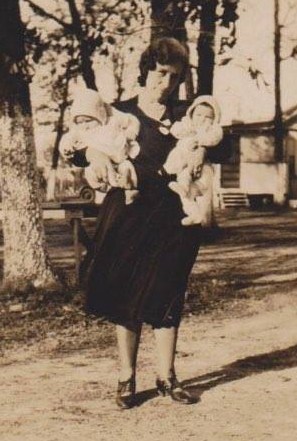

Emma Louise Strickland Tippett
 (1888-1949) - photo by Lisa Quigley
 Veitch (great grand-daughter)

By Feb-1919, the local secretary was Mrs. Leonora Odom.


Source: The Woman's Label League Journal Feb-1919, Page 15


In 1918, Mrs. Hunter filed the following report to the convention regarding the activities of her organization.
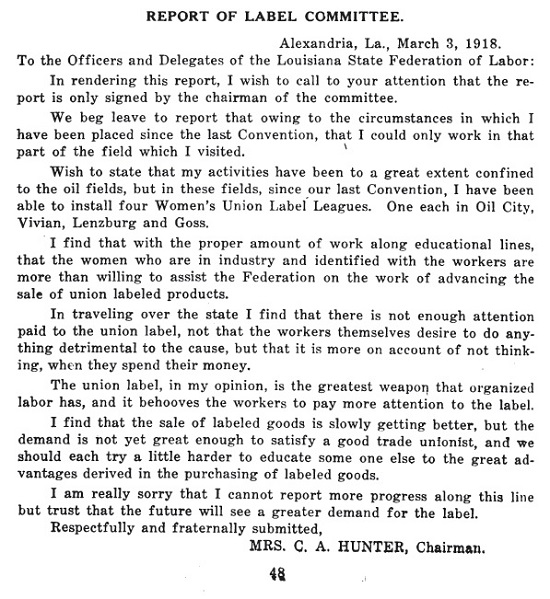
Louisiana State Federation of Labor. 6th-7th 1918-1919, Page 48


The following is a letter submitted by Mrs. Odom (name misspelled below) on the status of the Oil City local.


Source: The Woman's Label League Journal 20-May-1921, Page 10

Leonora's tie to Oil City is verified by her husband William T. Odom's World War I draft registration, Interestingly "in parish jail" is his listed occupation. Whether union-related or because of simple criminal activities is not known.

No subsequent information on the union or local chapter has been found.


Information about the early women's movement is available at this link.


Monday, October 26, 2015

Camping On Caddo Lake, Circa 1923

A little girl writes her aunt and cousins to tell about a Fourth of July family camping trip on Caddo Lake near Oil City. They slept in tents and brought along ice cream, Coca Colas, and chickens to eat in case the fish weren't biting. What's remarkable about this tale? This could have happened this past Fourth, and be referring to the activities of likely several families.

In this case however, the occasion described by Susie Lee Guess of Oma, MS took place in 1923. The "aunt" and "cousins" were not literal relatives, but the author and and other readers of a column titled "Aunt Jane's Letter Box" that once appeared in a children's section of the New Orleans Times Picayune newspaper. The section contained cartoons, stories, games, and "Aunt Jane's" column. Here children wrote to tell of their accomplishments and experiences and receive acknowledgement and encouragement for their "aunt." It was a sort of social network in the days before the internet and smart phones, as children could "network" by becoming penpals with other children ("cousins") who read the column.

Note the graphic above is foreshortened from the original that spanned an entire newspaper page.


Friday, October 16, 2015

Germans Invade Oil City!

Basil Fawlty: Is there something wrong?

German Guest: Will you stop talking about the war?

Fawlty: Me? You started it.

Guest: We did not!

Fawlty: Yes, you did. You invaded Poland.


During World War II, the Germans invaded Poland, France, Russia, and....Oil City. What, you say??? True, no Panzers ever rolled across the countryside, supported overhead by Luftwaffe air power. However in July 1945, over two months after VE Day and only weeks before the surrender of Japan, two German prisoners-of-war passed through town during a daring escape.   

In May, 1945, the U.S. War Department announced German prisoners-of-war would be located to various work camps around Louisiana to mitigate the agricultural labor shortage caused by the war. One such site was at McCain's Gin, north of Shreveport and near Blanchard, where 150 prisoners were located. This was likely near McCain Road, located between Blanchard and Mooringsport.


Source: Taylor (TX) Daily Press 31-May-1945, Page 5


While interned there, Rolf August Lendle (shown below on the right) and accomplice Willi Wurzbacher escaped from the compound on the evening of 23-Jul-1945 or in early morning of the 24th. Note Charlie King, shown on the left, escaped from another location in an unrelated incident. For those curious, his father was American, hence the non-foreign sounding name, but he grew up in Germany.

Following the Kansas City Southern railroad tracks north, their plan was to go to Texarkana and catch a train to Mexico, from which they would return to their homeland. The two split as they approached Oil City, with plans to reunite on the north side of town. After waiting a while for Lendle who did not show, Wurzbacher continued alone and was captured near Vivian on the 27th.


Monroe News Star 12-Mar-1946, Page 5


A description of Lendle, wearing his German uniform, but with American G.I. shoes.


In August 1945, the FBI notified Mississippi authorities of a possible Lendle sighting near Waveland, MS (close to Bay St. Louis). Perhaps he never intended to reconnect but instead wanted Wurzbacher to serve as a decoy continuing north, while he traveled in the opposite direction.


Regardless of the direction he took, as of 06-Jun-1946, he was still at large and no further mention of him appears, Did Lendle eventually make it back home to Germany? Did he assume a new identity and make a life for himself in America? Or did he reach Mexico, but decide to stay? Interestingly found was record of a Rolf Eduardo Lendle Rugarcia graduating from a Mexican university in 1984. A son, perhaps?  


Source: New Orleans Times Picayune 06-Jun-1946, Page 21


Friday, October 2, 2015

Cotton Comes To Cleveland

Mrs. Hattie Carter of Cleveland, OH with cotton grown from seeds her husband planted in their backyard garden. J. H. Carter is a builder who works the winter months in Oil City, LA and has had reported success growing cotton and pecan trees brought back from there.


Saturday, September 26, 2015

A Streetcar Named Ananias

Imagine Stanley Kowalski yelling "Hey Stella!" while standing in the street, only the setting is not New Orleans, but instead Oil City; and the street car runs on Ananias (OC's former name), not Desire, Street. Naah, I can't either. (smile) 

However, in 1912 New Orleans street car conductor and aspiring author and playwright Christian Joseph (not "F.") Meunier  (1889-1946) did write a novel  in which the main character is from OC. Titled "The Minister Of Peace," it is the fictional story of Jack Truce, a local oil field superintendent, and his fight for worker justice that takes him all the way to leadership of organized labor and a meeting with the President of the United States. Author Meunier provides a plot synopsis in the article below..


Source: New Orleans Item 23-Sep-1912, Page 4

While it's not known if the work ever reached New York publishers, illustrator Robert Emile Heier (1887-1932), similarly a streetcar conductor, did later move to that city where he worked in a similar position for a Brooklyn railway line.

There is no explanation available why Christian selected Oil City as home for his hero. Census records indicate he lived in New Orleans his entire life. This was an era though of real and/or perceived oil company excess and exploitation, and the town was one of the preeminent sites of related activity at that time. He must have been quite a creator as in addition to the aforementioned novel, he later copyrighted a play, "The Sporting Woman," and held patents for inventions that included a combination pen-filling inkwell and fountain pen set and bank protecting device.

His home, mentioned in the article at 827 Poland Street still stands today.


Return to Blog Post Table Of Contents

Friday, September 25, 2015

The First Marshall, TX To Oil City, LA Auto Trip

Excerpts from a full-page advertisement in the Dallas Morning News that touted the reliability and ruggedness of a Buick automobile owned by Dr. L. A. Decker of Marshall, TX. Among accomplishments cited was a successful 90 mile round-trip to Oil City over what was likely a patchwork of virtual cattle trails and deeply rutted dirt roads. In those days a gravel road was considered "improved" while paving was mostly unheard of in rural settings. Note in the testimonial by R. Beach, even after crossing Caddo Lake at Mooringsport, the ferryman expresses doubt the travelers can complete their journey; which is a simple three-mile drive today.


Friday, August 21, 2015

An Advocate For Local Oil Workers

John Glover Mynatt (1884-1918) was an oil field worker who became a local leader during the organized labor movement that swept oil fields from Louisiana, Texas, and out to California in 1917-1918, that included a strike by workers and resultant occupation of oil fields by federal troops.


Source: The Hennessee Family


Originally from Tennessee, here he is listed as living in Oil City when registering for the draft for World War I.


U.S. World War I Draft Registration Cards, 1917-1918


In late 1918, he attended a convention held in El Paso, Texas; where he was selected to serve on the union's Rules and Order of Business committee. Note also H. Hill (no first name given) of Vivian served on the Resolutions committee.


El Paso (TX) Herald 27-Nov-1918, Page 5


Unfortunately he becomes ill and dies while at the convention; leaving a wife, Estelle Lavinia Smith Mynatt and children John Rupert and Cecilia Estelle.


El Paso (TX) Herald 04-Dec-1918, Page 10


Died of influenza and pneumonia (per death certificate), part of the Spanish Flu Pandemic of 1918.


Source: Texas Death Certificates, 1903-1982

He is buried in Greenwood Cemetery, Knoxville, TN.


Below is a history of the Oil City union local.


History Of Oil Workers International Union (CIO) O'Connor 1950, Page 281-282

Histories of area locals may be found here.