Thursday, February 11, 2016

Oil City Burning

Did Mrs. O'Leary perhaps move to Oil City from Chicago and bring her cow along? (smile) All or significant portions of downtown Oil City have burned seven different times - in 1909, 1911, 1917, 1922, 1926, 1936, and 1939. A 1916 fire destroyed two hotels and the stable in which it originated.

1909

The earliest found incident of a town-wide fire occurred in January 1909.


Among buildings destroyed was the Norman Hotel.


29-Jul-1979 newspaper article (presumably the Shreveport Times or possibly (Vivian) Caddo Citizen (copy provided by Regina Rushing)


Another casualty was the Oil City Hotel, Cafe, and Ice Cream Parlor; along with the adjoining pool room, shown below.


Technical World Magazine, April 1909


1911

Two years later, the town east of the tracks again burned.


The Thibodaux (LA) Sentinel 09-Dec-1911 Page 1


1916

The Virginia and Norman hotels burn along with a stable in which the fire originated.


1917

Fire! (Again) As originally reported, some held suspicion of its ignition being related to labor strife present at the time. Striking oilfield workers instead aided occupying federal troops in extinguishing the blaze. This influx of manpower may have been the reason it ultimately proved to be a less severe, as were the resultant damages.


Shreveport Times 04-Nov-1917, Page 1


Charles N. Cheshier , Producers Oil Company Superintendent, directed the fire fighters.


Charles N. Cheshier (1918 passport photo)

Additional information from another account of the fire.


Paris (TX) Morning News 04-Nov-1917, Page 1


1922

Another fire burns a sizable chunk of the east side of downtown.


Scenes from the 1922 fire, both looking south.


Sam Collier's book "North Caddo Parish" as obtained from the Louisiana Oil & Gas Museum 


A Shreveport brick company used a scene and details of the damage to promote its products.


Shreveport Times 13-Aug-1922, Page 23


1926

Yet another major fire in OC, with only the bank, a brick structure, reportedly the sole remaining building on the west side of the railroad tracks. 


Monroe (LA) News Star 21-Sep-1926


The incident was even reported in a New York City German language newspaper.


New Yorker Volkszeitung 22-Sep-1926, Page 2


1936


Yet another major fire, said to have originated in the Strand Theater, burned multiple downtown buildings in 1936. At the time the town had no water system and no fire department - volunteer or otherwise. The sole source for fighting the blaze was a privately-owned wooden tank of salt water, which itself became a casualty as shown in the first picture below.


This follow-up article published the following day provided more details of what was damaged and the associated costs.


1939


The last (hopefully) of the major downtown fires, again on the west side. Based on the description, these were north of the Dixie Mercantile building on Land Avenue. Nathan's, Warren's, and Eggleston's would continue to conduct business for many years in other brick structures. 


Return to Encyclopedia Oleum Civitas.

Wednesday, November 25, 2015

Excuse Me! (Ahem) Where Do I Sign Up?

Due to a high-producing oil well on club property, instead of paying dues, members of the Jeems Bayou Hunting & Fishing Club received royalty income. The well, drilled by the Producers Oil Company, flowed at the rate of 9,500 barrels per day. For their share, each of the 56 members received $422 per month, the equivalent of $10,138 today. The club was originally called the Ananias Hunting & Fishing Club and its name was taken for the train stop on the Kansas City Southern Railway tracks that ultimately became the town of Oil City.

Among the members, comprised of Shreveport and Texarkana citizens is former Louisiana Governor Newton Crain Blanchard.


Monday, November 9, 2015

Colonel James Daniel Anders (1916-1986)

Anders, James Daniel (1916-1986) Colonel, U. S. Army 1942-1971

Source: Baton Rouge State Times 11-Aug-1965, Page 79 (13-F)

Among the colonel's accomplishments:
  • Entered U.S. Army as buck private in 1942 and retired 28 years later as a full colonel.
  • Awarded the Silver Star and Bronze Star medals during World War II; and also served in Korea, and Vietnam
  • Acted as technical consultant for film, "Teresa" that included actors Rod Steiger, Lee Marvin, and Robert Wagner among its cast
  • Testified before a U. S. Senate Subcommittee that included several notable senators of the day; in a hearing also attended by future Attorney General, U. S. Senator, and Democratic presidential candidate Robert Kennedy.
  • Served as chief-of-staff at Fort Polk, LA where he built a replica Vietnamese village to prepare soldiers entering that conflict. 

Early Life

Born 09-May-1916 to the Reverend Dan Frank, a Methodist minister, and Lucy Moffet Anders. His obituary states Oil City as his birthplace, however in a newspaper article about his military career, Minden, LA is mentioned as his place of birth. Rev. Anders pastored at several Louisiana churches over his career, including nearby Ida, LA in the early 1920s. The family moved from Jena in 1936, and Rev. Anders served as Oil City pastor until 1938.


Source: Monroe News Star 16-Dec-1936, Page 2


In 1940, James was still living in Oil City, boarding in the home of Henry H. and Maggie Smith Warren, with the occupation of oil pipeline clerk.


Source: 1940 U.S. Census


He married the former Annie Lee Waldron, a long-time resident of Oil City; who is shown below as a student at Louisiana State Normal College, now Northwestern State University.


Source: 1940 LSN Potpourri (yearbook), Page 64


World War II

James enlisted into the U. S. Army on 04-Aug-1942, shown then to be resident of Jefferson, TX.


During WWI, he served in 91st Infantry Division and was awarded the Silver Star.


Source: The 91st Infantry Division in World War II, P398


He rose quickly through the ranks. Starting as a private, he became a second lieutenant only eight months later, and made first lieutenant a year after that.


Source: U.S. Army Register, 1948


Later Military Career

In 1950, then Captain Anders served as a technical consultant for the film "Teresa" Part of the fictional story was set in some of the same areas the captain had traversed during the war. Listed among its cast were actors Rod Steiger, Lee Marvin, and Robert Wagner.

1951 Movie Poster
The original trailer is linked here.


Senate Subcommittee Hearings 

In March 1955, Lt. Colonel Anders was called to speak before the U. S. Senate's Permanent Subcommittee On Investigations regarding the handling of the promotion and discharge of Irving Peress, an army dentist suspected of communist leanings during the "Red Scare" era of the early-to-mid 1950s. This was a continuation of subcommittee activities begun earlier under then chairman, Joseph M. McCarthy, senator from Wisconsin. While  no longer chair, McCarthy was still a member of the the committee.

Service history contained in the official record of his testimony.


The hearing in which Colonel Anders testified was held 16-Mar-1955. Subcommittee members in attendance included: McClellan, John L. (Chairman) Bender, George H. Ervin, Sam J., Jr. Jackson, Henry M. McCarthy, Joseph R. Mundt, Karl E. Symington, Stuart Also in attendance was General Counsel, Robert F. Kennedy.


Hearings Before The Permanent Subcommittee On Investigations Of The Committee On Government Operations, United States Senate, Eighty-Fourth Congress, First Session, Part 1, March 16, 1955, Page 75 His full testimony is linked here. By 1964, he had been elevated to full colonel.


Source: U.S. Army Register, 1966

The picture below is from a 1965 article about francolins, an asian game bird, being introduced to the greater Fort Polk property for eventual hunting. (Author's observation: It's not mentioned if consideration was given to the potential impact on native species and the local environment.)


Source: Baton Rouge Morning Advocate 21-Nov-1964 Page 45 (10-C) (Anders with francolin)


Among the colonel's accomplishments while at Fort Polk is the creation of a Vietnamese village (shown below) in order to prepare soldiers about to enter that conflict.


Source: Baton Rouge Morning Advocate 28-Feb-1966, Page 20 (6-B)


In 1971, he retired from Ft. Polk chief of staff. recaps career, known as "Mr. Ft. Polk."

Civilian Contributions Per his obituary, his civic roles included:
  • Past president of Leesville-Vernon Parish Chamber of Commerce 
  • Member of the First United Methodist Church of Leesville, where he served on the Administrative Board for 20 years and was a member of the Chancel Choir
  • Member of the Leesville Lions Club, the American Legion and the Veterans of Foreign Wars
Colonel Anders passed away 02-Jun-1986 and is buried in Forest Lawn Memorial Cemetery, Leesville, LA.


Tuesday, November 3, 2015

Woman's International Union Label League

Though not working in the oilfields themselves or participating directly in related oil worker union activities, women provided support to their men through participation in the Woman's Label League, a nationwide organization described thusly:

Organized March 11, 1907 under the auspices of the Central Trades and Labor Council, the Woman's Union Label League encouraged the purchase and use of union label goods. Ladies belonging to the organization;were predominately wives of the union members. The first president was;Mrs. W. T. Ecks. 

Source: LSU-Shreveport Archives Collections

The following objectives appeared at the front of their official publication.


Source: The Woman's Label League Journal Feb-1919, Page 2


Excerpt of a list of organizations using labels on their respective manufactured products.


Examples of advertisements supporting the purchase of union-made products.


Though some union men questioned the value of the label league, it was promoted to add cohesion to the overall labor movement, in this case giving women a way to participate.


Mrs C. A. Hunter (first name not known), identified below as president of the Shreveport chapter of the Women's Labor league, is noted as the only woman attendee to a 1917 state labor convention. Her husband, C. A. Hunter, appears in publications at different times representing the oil workers union from Oil City and Mooringsport.


New Orleans States 02-Apr-1917, Page 7


Charters were issued in Dec-1917 for Oil City and Vivian, its neighbor community in the Pine Island District. This was during the time of the oil workers strike that occurred in the southwest from Louisiana to California. For more on that subject, read An Advocate for Local Workers and Occupied.


An early secretary of the OC local was Mrs. Emma Tippett. Note a Vivian contact was not listed.


The 1920 U.S. Census shows Emma Tippett (age 22) living in Caddo Parish, LA Ward 2 (that includes Oil City) with husband William Robert (29) and daughter Marguerite (one month old).


In the Aug-1918 edition, the OC local was shown to be led by Mrs. Susie Smith.


Source: The Woman's Label League Journal Aug-1918, Page 15


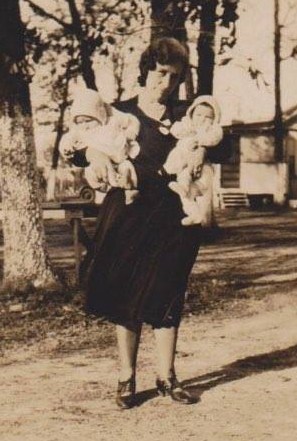
Emma Louise Strickland Tippett
 (1888-1949) - photo by Lisa Quigley
 Veitch (great grand-daughter)

By Feb-1919, the local secretary was Mrs. Leonora Odom.


Source: The Woman's Label League Journal Feb-1919, Page 15


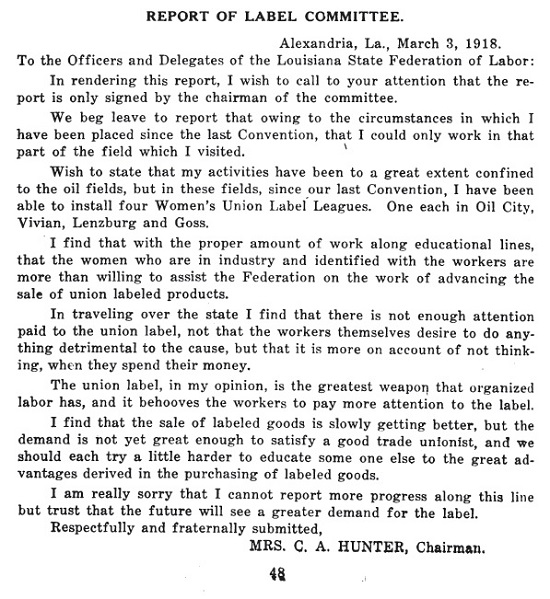
In 1918, Mrs. Hunter filed the following report to the convention regarding the activities of her organization.

Louisiana State Federation of Labor. 6th-7th 1918-1919, Page 48


The following is a letter submitted by Mrs. Odom (name misspelled below) on the status of the Oil City local.


Source: The Woman's Label League Journal 20-May-1921, Page 10

Leonora's tie to Oil City is verified by her husband William T. Odom's World War I draft registration, Interestingly "in parish jail" is his listed occupation. Whether union-related or because of simple criminal activities is not known.

No subsequent information on the union or local chapter has been found.


Information about the early women's movement is available at this link.


Monday, October 26, 2015

Camping On Caddo Lake, Circa 1923

A little girl writes her aunt and cousins to tell about a Fourth of July family camping trip on Caddo Lake near Oil City. They slept in tents and brought along ice cream, Coca Colas, and chickens to eat in case the fish weren't biting. What's remarkable about this tale? This could have happened this past Fourth, and be referring to the activities of likely several families.

In this case however, the occasion described by Susie Lee Guess of Oma, MS took place in 1923. The "aunt" and "cousins" were not literal relatives, but the author and and other readers of a column titled "Aunt Jane's Letter Box" that once appeared in a children's section of the New Orleans Times Picayune newspaper. The section contained cartoons, stories, games, and "Aunt Jane's" column. Here children wrote to tell of their accomplishments and experiences and receive acknowledgement and encouragement for their "aunt." It was a sort of social network in the days before the internet and smart phones, as children could "network" by becoming penpals with other children ("cousins") who read the column.

Note the graphic above is foreshortened from the original that spanned an entire newspaper page.


Friday, October 16, 2015

Germans Invade Oil City!

Basil Fawlty: Is there something wrong?

German Guest: Will you stop talking about the war?

Fawlty: Me? You started it.

Guest: We did not!

Fawlty: Yes, you did. You invaded Poland.


During World War II, the Germans invaded Poland, France, Russia, and....Oil City. What, you say??? True, no Panzers ever rolled across the countryside, supported overhead by Luftwaffe air power. However in July 1945, over two months after VE Day and only weeks before the surrender of Japan, two German prisoners-of-war passed through town during a daring escape.   

In May, 1945, the U.S. War Department announced German prisoners-of-war would be located to various work camps around Louisiana to mitigate the agricultural labor shortage caused by the war. One such site was at McCain's Gin, north of Shreveport and near Blanchard, where 150 prisoners were located. This was likely near McCain Road, located between Blanchard and Mooringsport.


Source: Taylor (TX) Daily Press 31-May-1945, Page 5


While interned there, Rolf August Lendle (shown below on the right) and accomplice Willi Wurzbacher escaped from the compound on the evening of 23-Jul-1945 or in early morning of the 24th. Note Charlie King, shown on the left, escaped from another location in an unrelated incident. For those curious, his father was American, hence the non-foreign sounding name, but he grew up in Germany.

Following the Kansas City Southern railroad tracks north, their plan was to go to Texarkana and catch a train to Mexico, from which they would return to their homeland. The two split as they approached Oil City, with plans to reunite on the north side of town. After waiting a while for Lendle who did not show, Wurzbacher continued alone and was captured near Vivian on the 27th.


Monroe News Star 12-Mar-1946, Page 5


A description of Lendle, wearing his German uniform, but with American G.I. shoes.


In August 1945, the FBI notified Mississippi authorities of a possible Lendle sighting near Waveland, MS (close to Bay St. Louis). Perhaps he never intended to reconnect but instead wanted Wurzbacher to serve as a decoy continuing north, while he traveled in the opposite direction.


Regardless of the direction he took, as of 06-Jun-1946, he was still at large and no further mention of him appears, Did Lendle eventually make it back home to Germany? Did he assume a new identity and make a life for himself in America? Or did he reach Mexico, but decide to stay? Interestingly found was record of a Rolf Eduardo Lendle Rugarcia graduating from a Mexican university in 1984. A son, perhaps?  


Source: New Orleans Times Picayune 06-Jun-1946, Page 21


Friday, October 2, 2015

Cotton Comes To Cleveland

Mrs. Hattie Carter of Cleveland, OH with cotton grown from seeds her husband planted in their backyard garden. J. H. Carter is a builder who works the winter months in Oil City, LA and has had reported success growing cotton and pecan trees brought back from there.